Wednesday, March 13, 2013

13 lessons I've learned on how to have a productive discovery meeting

Here are 13 lessons I've learned over the years about how to have a productive discovery meeting with a client. It's during these meetings that we develop our understanding of our client and build strategy.

1) Pay close attention to body language throughout the meeting. It lets you know how much you may need to elaborate on a question or move on to other topics.

2) Establish trust by showing you are making an effort to really understand their needs early on.

3) Try not to ask generic questions. Build your questions based on previous answers. Progressive questions will lead you to a better understanding of needs.

4) Try to find easier ways to illustrate ideas presented by the client through metaphor or personal anecdotes. It will show a true want for a deeper understanding and also allow you to know if you are on point.

5) Really show them who you are during the meeting. Be yourself.

6) Don't be afraid to ask "dumb" questions. We tend to ask questions based on an initial intellectual need. It may help to elaborate after the answer is given on why the question was relevant to you and what you learned from the answer.

7) Remember you are the "expert," so be confident and share some industry wisdom.

8) Remember that you are discussing a topic that is deeply personal to the client, so act accordingly.

9) There is always a hidden truth that will teach you something really valuable. If you don't know that truth, you must dig deeper.

10) Remember that it is a process. If you don't feel you've found what you are looking for in the allotted time, schedule a new meeting.

11) At some point, explain to the client an idea or thought given to you by the client. The hope is that the client will begin to think in terms of marketing. This will make the relationship more valuable and effective.

12) The best way to impress a client during a discovery meeting is to show you were paying attention. Make sure they see that you have been.

13) And most importantly, after the meeting, do what you said you were going to do. It's much easier to lose integrity than build it.

The Power Of Photoshop

The Shining
Six years ago a close family friend broke the news that their 9-year-old daughter, Claire, was diagnosed with acute lymphoblastic leukemia (ALL). Hearing such devastating news about people that you care so deeply about immediately gives you a deep feeling of helplessness. Claire’s father signed up to be a shavee for St. Baldrick’s that year and my wife, daughter and I attended to show our support. Being a fan of all things Irish, I was taken over by the incredible energy of the night… the music, the kids, volunteers and of course, the shavees! I was so inspired that I signed up the following year myself. I've been a passionate supporter ever since. 

Anyone who has ever been tasked with fundraising knows it is sometimes difficult to draw interest. I decided that the best way to create a donor opportunity was via social media, mainly Facebook. The core of running an effective social media campaign is "sharing." A lot of sharing. A strategy developed from that idea. I knew that just publicly thanking the donor for their generosity via Facebook was not enough. How could I make that "Thank you" bigger and more noticeable to others in the process? I decided to combine my passion for helping families dealing with childhood cancer and my passion for graphic arts. 

Star Wars
I decided to begin offering the donors photoshopped images as a way to recognize people's generosity but also to draw attention to the cause in a light-hearted way. I then made sure to keep all these images in a special folder so that they could be seen collectively and inspire others to give. The reaction was immediate.  Friends and family tried to "out do" each other by coming up with the most humorous photo ideas.  Some were based on their kid's favorite movie, some based on a historical moment, some just plain bizarre!  But each was personal and made the donor want to share it with their own family and friends, which introduced many people to the efforts of the St. Baldrick's Foundation.   

I believe it's important to acknowledge the charitable nature of others but also make the participants. It becomes a chain reaction that motivates more generosity. St. Baldrick's is a constant reminder of the power and importance of our children. And I believe the silly nature of this particular way of raising money has become a nod to the spirit of fun found in every child. Although it feels like the love we have for our own children is the most powerful feeling in the world, we must remember it is not unique to us. It's that love that gives families strength during trying times. I believe that is what motivates our family most and why we are all so passionate about the St. Baldrick's Foundation. 

Finding a way to inject fun into your fundraising efforts not only increases your donations, but also encourages others to join the cause.  I have found that by just offering this one incentive, my donations have increased considerably as the years progress.  And I love every minute of it!


Here are samples from the last campaign


Flash Gordon


Goonies


Love Actually

Where the wild things are


An offense that comes from misinterpretation is vulnerable


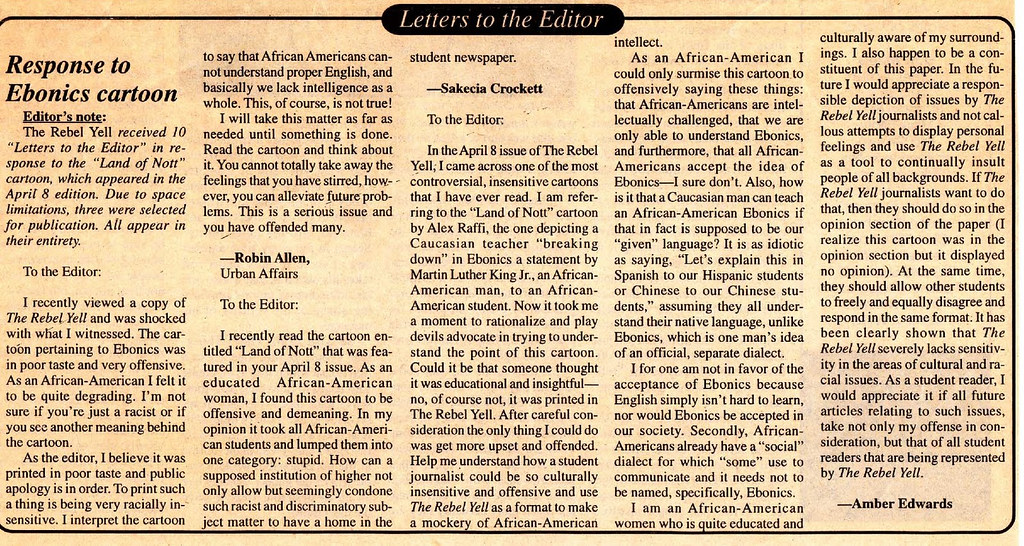
No sooner had the above cartoon been published than complaints from offended readers began to reach the offices of The Rebel Yell, student newspaper of the University of Nevada in Las Vegas. It was early-1997, not long after a controversial decision by the school board of Oakland to recogniseEbonics as a primary language had kick-started a national debate, and editorial cartoonist Alex Raffi had clearly hit a raw nerve with his irony-steeped piece. Multiple allegations of racism provoked the newspaper's staff to publicly back him, whilst Raffi himself drew another cartoon and offered explanations to as many people as possible, but it was this letter from Pullitzer Prize-winning cartoonist Berkeley Breathed in response to a request for guidance that provided the advice needed. Says Raffi:
Amazingly he offered me his advice. I learned a lesson early on that doing this kind of work is a privilege. You better be clear on what you mean. I still believe in the point of the cartoon but I executed it very poorly.
Transcript follows. Huge thanks to Alex Raffi for his permission to feature the letter.


Transcript
BERKELEY BREATHED

June 3, 1997

Alex,

Welcome to Editorial Cartooning. Having fun yet?

At your age and position, I went through an eerily similar situation. The offended were Hispanics at the University of Texas. They wanted my internal organs on a platter. My reaction was the same as yours: respond with a cartoon about everybody being so damned over-sensitive.

But... and this is a big one. But, I am now embarrassed looking back at the cartoon I had defended so defiantly before. I could have made the same point without pushing the delicate buttons. These skills I would learn in the following years... to a degree. Offending folks is a dandy pastime. It's our job, in a way. But an offense that comes from misinterpretation is vulnerable. Experience will teach you how to do so with minimal reader confusion... the Achille's heel of cartoonists. Offend with the cutting clarity of an idea well-expressed... and defend it to the death.

Finally, don't let the editors speak for you. That's not their job and they won't do it as convincingly. As a reader, I don't care what they say. I'd want to hear from you. If your point is well taken, but you can see where confusion was caused, then apologize for the latter, defend the former and pledge to continue with unwavering resolve and more practiced skill.

By the way, I am a member of PETA, and I am cancelling my subscription to the Rebel Yell due to the speciest nature of your other enclosed cartoon.

Go get 'em.

(Signed, 'Berkeley Breathed')

This was the spiciest cartoon he was referring to. Click image to enlarge.


Thursday, February 21, 2013

Please consider making a donation to my St. Baldrick's campaign.


Avery’s attitude about having a brain tumor is, “Some people get cancer and others don’t. This is just what I have to deal with.” Diagnosed with pilocytic astrocytoma, in June 2011, Avery had a craniotomy that removed about 60% of her tumor along with three months of steroids and is having eight rounds of chemotherapy. Her mom, Stephanie, says, “If anyone can handle this, it’s Avery… She’s a ‘can do’ kind of girl.”


I'm having my head shaved to stand in solidarity with kids fighting cancer, but more importantly, to raise money to find cures. Please support me with a donation to the St. Baldrick's Foundation. This volunteer-driven charity funds more in childhood cancer research grants than any organization except the U.S. government. Your gift will give hope to infants, children, teens and young adults fighting childhood cancers. So when I ask for your support, I'm really asking you to support these kids. BONUS: I'll photoshop either you or myself into any picture you like. Thank you! Click the big green dot to give online.


Thursday, December 27, 2012

We All Need Each Other


Thanks to our creative capacity and our ability to reason and innovate, the human organism possesses a great deal of adaptive flexibility. This is what allows it to survive in many different conditions. But it is also rigidly programed for certain environmental requirements. Just as our bodies require physical nutrients the human brain demands positive forms of environmental stimulus at all stages.

We must ask the question: Is the condition we have created in the modern world actually supporting our mental health? Is the bedrock of our socioeconomic system acting as a positive force for human and social development and progress? Or is our society actually going against the core evolutionary requirements needed to create and maintain our personal and social well-being?

In Creative Courage we discuss our tendency to amend problems instead of looking at the core of why there is a problem and why we need a solution. I think the need for a solution to our epidemic of violence in the world is clear. I believe we need to consider looking at the beginning of the chain reaction that ends in a member of our society feeling they must take up arms against children. The solution is bigger than what has been discussed. Gun control is not the answer and more guns isn't the answer either. There has to be a fundamental shift where we all realize we are not on our own and that we ALL NEED EACH OTHER and must work to protect each other as we progress in life. I don't have an easy answer. I don't think there is one. But I know that if the majority of us begin to work together, we will find a solution that will begin to make that shift.